











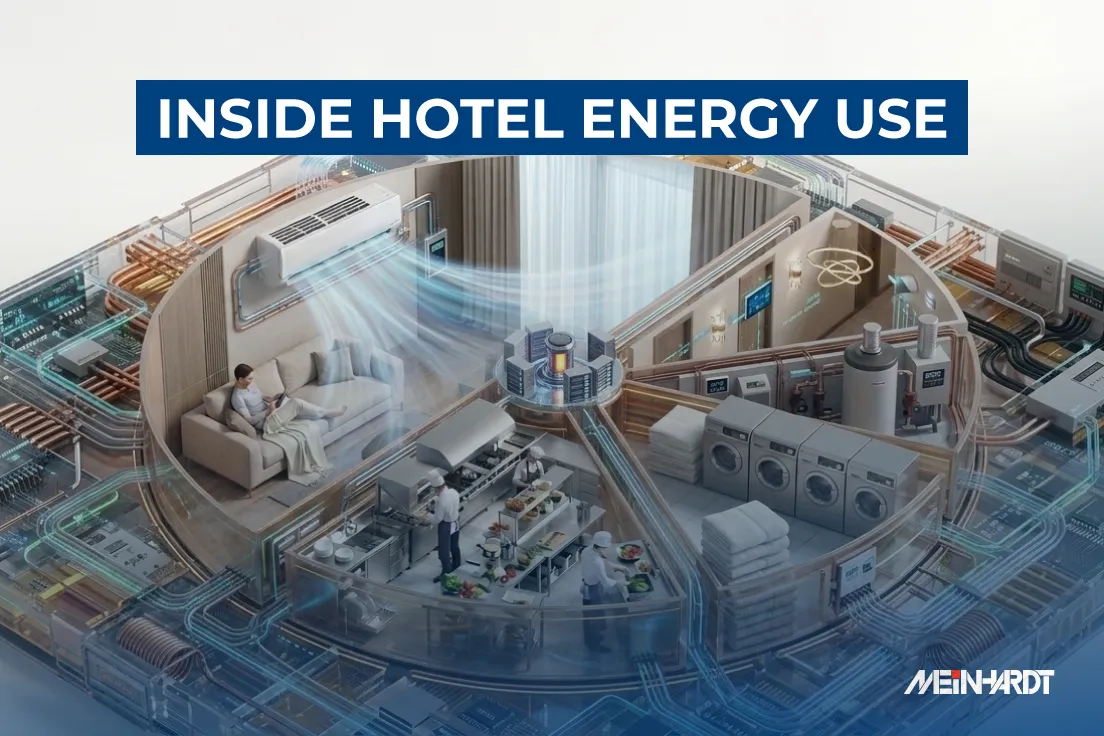
Inside Hotel Energy Use

In South East Asia, Hotel Energy Consumption is notably high, driven by tropical climates and premium service expectations. In markets like Singapore and Hong Kong, Energy Use Intensity (EUI) typically ranges from 250–450 kWh/m² annually, with some high-end properties exceeding 500 kWh/m². In Thailand and Vietnam, hotels generally fall between 140 and 300 kWh/m² depending on class and age.
Air conditioning (HVAC) is the primary driver, often accounting for 50%–60% of total energy use—and up to 70% in hot, humid environments. Luxury hotels can consume two to three times more energy than budget properties due to expansive public areas, amenities, and round-the-clock operations.
On a per-guest basis, energy consumption typically ranges from 20 to 50 kWh per night. To put that in perspective, 30 kWh could power an efficient electric vehicle for roughly 150–200 km or run a household refrigerator for 2–4 weeks. In many Southeast Asian cities, that’s equivalent to around 3–5 days of electricity use for a typical household.
This intensity is largely driven by the need for continuous climate control, highlighting the critical role of HVAC optimization in improving hotel energy performance.